
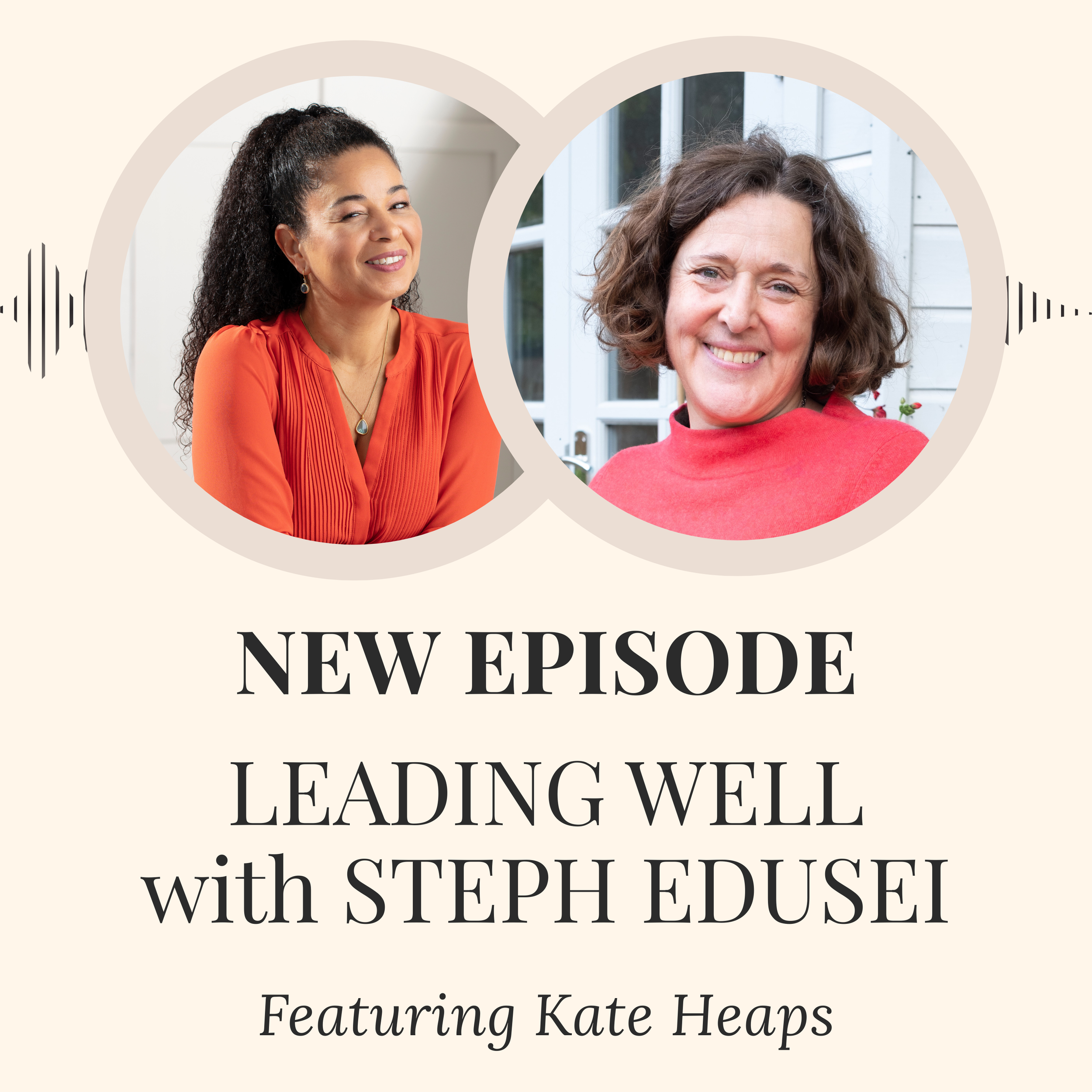
Want to explore what it means to lead well?
Leading Well is a membership space for thoughtful leaders who want to develop their leadership, protect their wellbeing, and lead in a way that is human, compassionate and sustainable.
Find out more about the Leading Well membership
About this episode
After 20 years at the same hospice, including 16 years as Chief Executive, Kate Heaps made the decision to leave.
In this episode of Leading Well with Steph Edusei, I talk to Kate about leadership, ambition, and knowing when it’s time to let go.
We explore the weight of responsibility that comes with senior leadership, how easily we can become accustomed to stress, and what happens when we begin to separate who we are from what we do.
We also reflect on what it means to lead compassionately and sustainably, and whether our ambition needs to change as we move through different stages of our lives and careers.
In this episode we explore:
The personal cost of leadership and responsibility
Recognising the impact of prolonged stress
Leadership, ambition and identity
Compassionate and sustainable leadership
Knowing when it’s time to let go
A conversation for anyone who has ever questioned what success looks like, or wondered whether it’s time to do things differently.
Read the full episode transcript
Leadership, Ambition and Letting Go with Kate Heaps
Transcript generated from the recording and lightly formatted for readability. Automatic transcription may contain errors.
Kate Heaps
Sometimes when, as a woman, you adopt a historically kind of trait that would be seen as a male trait, you do get criticised for it. I remember a colleague of mine, a manager of mine, once telling me, I need to be more feminine at work. And it was kind of like, I didn't quite know what he meant, but because, you know, sometimes, you know, you have to be decisive, you have to be directive, you have to be boundaried.
But I think, and I also know that, you know, at least I've got the privilege of being a white woman, right? I think as a black woman, you know, you'll be accused of being aggressive, you're, you know, all of these things that are just, if it was a white man, nobody would say anything. So I think there's something about having that ability to flex in and out of different styles.
Steph Edusei
Hello, and welcome to Leading Well with Steph Edusei. I'm Steph Edusei, and this is a space for conversations about leadership, self-worth, and what it really means to live well alongside responsibility. Today, I'm joined by Kate Heaps.
Kate has spent her career working across nursing, the NHS, voluntary sector and hospice leadership, with a deep commitment to palliative and end-of-life care, to communities, workforce development, and to social justice. And what really interests me about Kate's story is the way her leadership sits in work that's both deeply human and very complex. Hospice and palliative care ask leaders to hold emotion and responsibility, uncertainty, systems, resources, and relationships, and quite often all at the same time.
So I'm really looking forward to exploring what this kind of work teaches us about leadership, compassion, courage, and humanity. Kate, thank you so much for joining me. It's great to have you here.
I think it would be really interesting for the listeners to hear a little bit about your own leadership journey and what took you to palliative and end-of-life care.
Kate Heaps
Thank you, Steff. So I think my leadership journey actually happened around the kitchen table when I was growing up. My dad was in quite a senior position working in industry, and we would very much sit around the table and have conversations about our days, and that would include his day as well.
And sometimes, you know, he would share stories that had happened at work that were difficult, or things that he was proud of, or whatever else. And so I think that I don't underestimate the impact of that. And I think the other side is that my mum was a district nurse, and so when I was growing up in the 70s, she used to take me to work with her.
So she used to take me to her patients in the morning before she dropped me off at school. We used to go and see her diabetic patients together. So I kind of saw her role in action from a very young age.
And when I was at school and I wasn't quite sure what I was going to do, I decided that I would move into, train to be a nurse. And before I left school, I went to do some voluntary experience at a hospice in Sheffield and so that that would help me with my application for nursing. And so I suppose I've always had an interest in palliative care right from then.
And I went to do my nurse training. And as I was training at St Thomas', which actually had the first hospital palliative care team in the country. And I used to see the clinical nurse specialists in that team.
Clinical nurse specialists were not a common breed at that time. There were very few of them around. And what I saw was people who had much more autonomy, an ability to make decisions, to do compassionate care, and to really make a difference for those people who were facing the end of life.
And I thought, okay, maybe this is where I might be interested to go. So I guess inevitably, nothing in my career has really been very well planned. So although that inspired me, I ended up working in sexual health and HIV for a while.
And that was at a time when the HIV pandemic had really just started to take hold. And a lot of people who were HIV positive were dying of AIDS. And so my first palliative care role really was in HIV care.
And what I saw there was significant inequalities. I used to run a clinic with a doctor specifically for drug users with HIV, who were not allowed to be in the main clinic because the receptionist didn't like them. And for me, that was a real, really shocking experience.
And so I think as well, that kind of sparked my kind of passion for social justice, really. Anyway, I left that role, went to work in a charity, which was a drug rehab for drug users with HIV. And thankfully, combination therapy came in and most of our patients or residents stopped getting sick.
And within the course of about three years from when it opened, the project closed. And after various other bits and pieces that I did, I decided that I was going to go and do my district nursing course. And I guess that was the first time I had any formal leadership training.
I think the district nursing certificate really sets you up for managing a caseload of patients, but also understanding your population and the need within your community, but also how you're going to manage the people that work within your team. And so I guess that was the first time I did any kind of real management theory in a job where I was managing people. And I worked as a district nurse for several years before I moved into a job share as a palliative care nurse with a colleague.
We just so happened to be managed by the same line manager and an opportunity came up. And then my dad died very suddenly and I couldn't do the work. I found it very, very difficult to come back to work.
And I was finding that I was very cross and struggled in the kind of palliative care to be kind of empathic really with some of the patients. And so I decided it was time to step away from a clinical role. And I moved into a commissioning role for a bit before I joined the hospice that I've just left.
And I was there for 20 years as director of care and then as chief executive. And I suppose, so my leadership journey hasn't necessarily been a classic leadership journey, I think, but throughout all of those experiences, I've picked up skills along the way, learned from doing it well, but also from mistakes around what I could do better and taken on additional responsibility. But one of the things I say to people is leadership isn't about seniority.
I think it is about whatever role you're in, you can be a leader. And it is about speaking up, thinking about the big picture, supporting your colleagues, and kind of striving to do better, kind of setting that vision and kind of heading for that. And I suppose throughout my career, that's one of the things that I've always felt has been important, but also others have encouraged me to do.
Steph Edusei
So much in what you said there. But I think that last point about it's not about seniority, leadership is definitely not, I think. But we do tend to default to, oh, this person's got this job title, and therefore they're the leader.
But I know that there've been times when I've been sure that I'm not the right person to lead in that situation. And you step back, don't you? And you kind of go, okay, you've got the knowledge, you have the right skills for this, I'll follow you.
And whilst if you've got the job title, you still retain that ultimate responsibility. There's something about knowing when it's your time to step forward and when it's right for you to step back and let others take that on. The other thing I was really struck by actually was how it sounds like your leadership journey wasn't planned.
And I hear that so often. And yet we talk to people about, people are told, oh, you need to plan your career path. Have you ever come across anybody just out of interest that has had a plan and they've followed it?
Kate Heaps
I think there are people, definitely. And I think, you know, the NHS has a good leadership kind of programme, right? But I think, I don't know, I don't know if this is correct or not, but this is what I attribute a lot of it to.
And I think it is generational. I think when I was at school, girls didn't do management positions. In fact, they didn't do management full stop.
And I had very poor careers advice, as I think a lot of people did, girls and boys actually. But nobody at school or at home actually asked me the question about, you know, well, you're quite good at this, or you're quite good at that or whatever. It was just like, what do girls do?
They do nursing and teaching. And I suppose for me, I did go into nursing, and I'm not saying I regret it at all, because it's one of the best jobs in the world. But I did go into it because I didn't know what else to do.
And I didn't have that direction, I think, to think about other things. And I think that has changed, you know. And girls are given great opportunities now and encouraged in ways that we just weren't, I don't think.
Steph Edusei
No, and I think though, it is interesting. So the two areas that you've worked in, kind of the charity hospice sector and the NHS, and I've worked in both as well, are still heavily female in terms of workforce. And yet you look at the leadership, and it's still predominantly male.
How do you find the hospice? So hospices are so female, it's ridiculous. And yet you go, and it's almost like the bigger the hospice, the more likely it is that you're going to have a male in the chief exec seat.
How have you found that?
Kate Heaps
It's the same in nursing, right? You know, if you look at the statistics, the proportion of male nurses is relatively small. And yet when you look at male nurses in management positions, it's quite significant.
We just have to kind of continue to encourage all of our staff, not just the girls, obviously, or women, but the men as well, to make sure they're doing the right job. But I think, I think leadership, and I think again, generationally, or just in society generally, I think leadership is changing. I think, you know, that kind of bureaucratic, do as I say, not as I do, how high, you know, if I say jump, you say how high, that kind of stuff, that's, it's not gone completely, but it is disappearing.
And I think traits that have maybe been historically attributed to women, like empathy, like, kind of, just more of a kind of compassionate, inclusive, distributed leadership, we're seeing that a lot more in leadership from men and women, and that's good. So I think, and, and equally, I think, sometimes when as a woman, you adopt a historically kind of trait that would be seen as a male trait, you do get criticised for it. I remember a colleague of mine, a manager of mine once telling me I need to be more feminine at work.
And it was kind of like, I didn't quite know what he meant. But because, you know, sometimes, you know, you have to be decisive, you have to be directive, you have to be bounded. But I think, and I also know that, you know, at least I've got the privilege of being a white woman, right?
I think as a black woman, you know, you'll, you'll be accused of being aggressive, you're, you know, all of these things that are just, if it was a white man, nobody would say anything. So I think there's something about having that ability to flex in and out of different styles. And I think that's becoming more necessary in a kind of complex world.
And I think we're good at that. Because we have to, you know, you know, I know, it's a kind of cliche, but multitasking, we have to go from one thing to the other and be able to, you know, be compassionate one minute and actually the next minute deal with something that needs a lot of direction or a lot of clarity. And so I think, hopefully, having more women sitting around the board table or in the exec team or whatever, is actually influencing how everybody manages, not how, not just how women manage, right?
Steph Edusei
Yeah, I hope it gives, it gives men more permission to be, because I genuinely believe that that a lot of men want to be able to lead in a way that feels more natural to them. And that does, that is empathetic, and that is compassionate, all those things. But, but they feel like they have to perform masculinity.
So maybe it's having more, more difference allows you to do that. I do wonder whether one of the reasons that generally women are better at that, being able to flex and change is because growing up, we have to, we've got to get good quite quickly at reading the room. And then we have to adapt to that, partly to keep ourselves safe and to get ahead.
You've got to constantly be working out, well, what is it that's going to please these people so they don't dislike me and harm me? Or how do I fit in with these people so that I can then get ahead and what have you? And I wonder whether that, unfortunately, because I don't think that's the way that life should be, but whether that actually is what trains us to be able to switch and almost like cold switching all the time.
Kate Heaps
Yeah, that kind of self-talk that says, I shouldn't be the person doing this in this room. That, um, I, I see that a lot with other women leaders that I support or work with, you know, and where they're saying, you know, even if you suggest to them that they might think about the next step up in their career, sometimes it's like, oh, I couldn't possibly say that I wanted to do my boss's job. That, and, and it's kind of seen as, ambition is seen as a kind of dirty word, you know, and, and that's not, and, and I think because often ambition is seen as something where you have to stand on other people to get to it, as opposed to actually it's something that you've earned and that you're going to be good at.
So I think, um, that's interesting as well, that we don't, we don't look at where we could be in the way that other, other men do, I think often.
Steph Edusei
Yeah. And I think you're spot on about ambition. There's a, um, I've actually had that used against me reasonably recently in that somebody said that they, that they thought I was very ambitious and was using my role as a stepping stone to the next role.
So what's wrong with being ambitious? And I think that particularly for women, it is used as something very negative that we shouldn't be, we should be grateful and content and not, not wanting to go on to more and to other things. Um, whenever anybody says ambition in the context of women, I think of Madonna, you know, a naked ambition, I think, and that very kind of aggressive form of ambition, which is exactly what you were describing there, wasn't it?
This kind of mercilessness.
Kate Heaps
But we're our own worst enemy in that context, because, you know, the, the issues around equal pay, for example, the equal pay gap doesn't just exist because organisations want to pay women less. It's because women don't ask for more money in the way that others will. And, and, and I think, you know, because it's seen as a negative thing to say I'm worth more, or we might not think that we're worth more, or we might feel that we are lucky to be where we are in our position and so on, so on.
Steph Edusei
Taking it back to kind of the voluntary community sector, but particularly, um, the hospice sector. I think there are a lot of really great things from my, my experience in working in that sector about being a leader in this sector. There's also some real drawbacks.
And what, what kind of do you think that people can learn from either positive or negative from, from leading in particularly hospice palliative care?
Kate Heaps
I think working in the hospice sector is, you know, a massive gift, because you have a space to be creative, to do things your way. Whereas in other parts of the health service, it's much, it's much more constrained. And I, I don't think we celebrate that enough.
And, and, of course, there are challenges with money. I, you know, I'm not playing those down at all. But to be able to say, well, you know what, we're going to try this new thing, and not have the bureaucracy of a large NHS organisation that you have to go through to do that is huge.
And it does drive transformation, not only in hospices, but across the system as a whole. And, and I think being a voluntary sector chief exec, in a working in a system, which we do, I think we have a responsibility, therefore, to use that creativity and the opportunity to do things differently, but to, to kind of challenge others to think differently, and to think about whether they could do it differently. But more than just to challenge them to help them find a way through it.
Because, you know, charities do have access to resources that other providers don't have. So that kind of generosity of knowledge and skills, but also of routes through other funding or whatever else. But to do it not because we think it's great for our hospice, but because we know the population needs it.
And, and sometimes I think that accountability doesn't exist for at a system level within hospices. I think accountability to our boards and to our community does exist, absolutely. But actually, we've got responsibility to improve services across the whole system, because in a world where you know, 50% of people thereabouts are still dying in hospital.
If we really care about how people are dying, we should be influencing how people die in hospital, as much as we should in our own inpatient beds or in our community services. So, so, and, and that means that when there are conversations about resources, for example, I think sometimes the conversations are the wrong conversations. Because a pound spent on district nursing, for example, is probably two pounds saved in a hospice.
But, but very often we're just focused on getting as much money as we can to do as much as we possibly can, as opposed to saying, do you know what, if you did more of this, we could do less of it. And your costs are probably lower than ours. And that, that kind of leaving the ego at the door.
So that we're not saying, oh, my hospice is a 20 million pound hospice or whatever. But it's a, you know, actually, we've reduced our expenditure this year. But we know that more people will get better palliative care.
Steph Edusei
Yeah. And that's a real challenge, isn't it, as a leader? How do you go back to your board, your team and go, actually, I think we need to take a step back?
Yeah.
Kate Heaps
How do we take a step back? I think, I think it's resisting the urge to take the step forward in the first place, actually. Because it's very difficult to step back once you start doing something.
And I also think that when you run a service with clinicians, they will see you stopping doing things as a cut in service. And also your supporters may well do that too. So I think it has to be done very carefully.
And you have to make sure that the gap is being filled by somebody else. And that things like equality is maintained. And those organisations that are going to fill that gap need your blessing, if you like.
And your comms needs to say, actually, we're not going to do this anymore, because so and so are going to do it. And they're going to do it just as well, because we're doing it in partnership and collaboration and so on. And that isn't easy to do, I guess.
But that comes with building trust and relationships within a system and then kind of trusting you as a provider and being the go-to provider to have those complicated conversations. But knowing that you're not just going to bash the table and say, we need more money. You can't go to those conversations just with certainty.
And I think often those negotiations start from a place of, you know, it's like buying a car, as opposed to working out a really complicated problem, where we say, this is how much money we need. And that's our red line. And we're not going to go beyond that and all of those kind of things.
And actually, the reality is that nobody's got any resource, right? And I think sometimes we negotiate for money to do things, new things, different things, and then we can't find the workforce anyway. So, you know, then we kind of look foolish, actually.
So, actually being a bit less certain about everything and testing stuff out and collaborating on these things is a much better way to do it.
Steph Edusei
Yeah. And I see you very much as being a system leader, because you've kind of, you've held those roles, they've bridged different organisations. What's that experience like?
And how have the skills that you've needed to do that been different to some of your other leadership roles?
Kate Heaps
I think it's challenging. Wearing lots of hats is challenging. And as you know, I've just stepped down from the community hospice in March.
And while I was there, I was also the clinical lead for the ICB for palliative care. I've continued to do that role post leaving the hospice. And although it puts more pressure on the time now, because often I was in a meeting wearing two hats, whereas now I'm not able to do that.
I think I always felt as though I was being fair to make sure that all of the providers were represented and disciplines were represented and what have you. But inevitably, others would have seen me as a hospice person. And I hope that now I'm not wearing that hat.
It's easier to kind of leave that one at the door if it doesn't need to be there and think about how we involve others. And to play devil's advocate a bit with hospices, which, and I don't mean that in a negative way, because we've got a great working relationship with our hospices. But, you know, there are 20 odd providers in South East London providing palliative care, not all specialist palliative care, obviously.
But that means that we need to make sure that we're engaging with all of those people and thinking about who's going to do what and how. And, you know, we need to upskill some of those providers to do more because that's a better way of doing it that, you know, community nursing is a really good example, but primary care as well, general practice, you know, those people are seeing these patients much more often than specialist palliative care ever will. So let's make sure they're doing as much as they possibly can within those roles.
Same with domiciliary care, you know, they're seeing those people, patients three times a day, right? Let's make sure they can do as much as possible on those visits. So that specialist palliative care has to do less, I guess.
Steph Edusei
Yeah. And I wonder whether some of it goes back to that maturity as well, trying to ensure that as many people around the table come with a level of maturity that can handle that. Actually, sometimes there will be some real challenge.
And that doesn't mean that I hate your organisation or want you to fail. It's just that that's really beneficial for the outcomes. And getting to the point is we want to do what's best for, in this case, patients and their families.
I don't think we see enough of that yet. No, I don't think we do.
Kate Heaps
And I think I was thinking a bit about this in preparation for today. Have you heard of the endowment effect? It's a, it's a psychological theory that says that if we own something, we value it more than the thing, the identical thing that we don't own.
So, you know, like our childhood teddy bear.
Steph Edusei
Yeah.
Kate Heaps
And I think we see that probably in lots of places, not just palliative care, actually. But I think we see it with our clinicians where, you know, that thing around who, which, which people, patients are we not reaching? It's difficult to stop doing things for the patients that we are seeing in order to see the ones that we're not seeing because they haven't got a relationship with those.
So they're not real people and they don't matter as much. And I don't, it's not a conscious thing, it's a subconscious thing. But equally, I think, you know, we care more about the organisation that we're in than we do about the one that we haven't got anything to do with because we haven't got anything to do with it.
Steph Edusei
Yeah.
Kate Heaps
And, you know, just a recognition that sometimes those other organisations might be much better placed to do these things is important, I think, in our complex systems.
Steph Edusei
It is really challenging, isn't it? Because in a lot of these situations, there's an element of self-interest as well. And I mean, real self-interest, not organisational self-interest in that you're dealing with situations where actually that might mean that I don't have a job or I have less of a job or I have less of a profile, I may not be sitting around that table.
And that fear of missing out and not being a part of something can be quite real. So being able to step out of that personal and kind of quieten that noise, and then you've got the organisational noise is incredibly challenging, I think. Any tips for that one, Kate?
Kate Heaps
Can you solve that problem? I can't solve it. I mean, I think in healthcare, for me, it becomes a, certainly within the kind of clinical teams at least, the argument becomes academic, who's delivering the care as an organisation, because you'll always need workforce.
And so if the job's not there, it's there anyway. And hopefully people, the thing is that it's really interesting because I have colleagues who work in the NHS who would not want to work in a hospice, and likewise others who work in a hospice who wouldn't want to work in the NHS. So there's that thing about what is it that's important to you about working for that organisation.
And actually, I was one of those people, before I joined community hospice, I said, you cut me through the middle, I've got NHS written all the way through. I'm going to go for three years, I won't stay, you know, all of those kind of things. But I suppose I had underestimated that kind of space for creativity, flexibility, those kind of things that I just didn't think I would have.
And I find it really interesting when you do have colleagues who just won't countenance working for another organisation. And yet, they're quite happy to criticise the one they work for. So, yeah, I don't have the solution, though.
I don't know what that solution is. I mean, I think people, some people are not very good at reading the room either, when actually, maybe it's time to move on, or their role isn't needed or whatever. Because we have to think about that.
And we, you know, you have a duty, right, to make sure that as a charity, or as a public body, that you're spending the charitable funds or the taxpayer's funds in the right way. And so, you know, maybe as staff, it's our duty to make sure that we're doing the right job as well. And if we're not, then we have a responsibility to move on, maybe.
But that's easy to say and less easy to do when you've got bills to pay.
Steph Edusei
And I'd be really interested, because you've been through a kind of journey of 20 years with an organisation and then deciding that it was time for you to leave. What led you to that? What kind of thought processes were you going through when you thought, this is, it's time?
Kate Heaps
I've been thinking about it for quite a long time. I was concerned that I'd been in the job too long. And because that's another thing that people say all the time is, she's been there a long time, you know, and it's kind of, I took that as a criticism.
And I think, other than medics, people do move around quite a lot in the health service. And so, I was kind of used to a job for three years, moving on to the next one, kind of so on, so on. So the fact that I stayed in the chief exec job for kind of 16 years does seem ridiculous, really.
But eventually, I, and I did have some really challenging times, kind of eight, nine years ago, with members of the board and or staff. So I did contemplate it then. But, but I got a new chair, who was just so good.
And I was loving working with her. And I kind of finally felt as though actually, I was able to lead in the way that I wanted to lead. Because for a long time, I felt quite constrained, actually.
And then I had this amazing team around me. So again, I was really enjoying that. And I was enjoying developing them, learning from them, all of those kinds of things.
And time just flies, right? And when, with my new chair, she and I talked about when I might leave. And we agreed that we shouldn't leave at the same time.
Steph Edusei
Yeah.
Kate Heaps
And I was anticipating going. And then she became a granny. And she was like, I really want to go now.
And I think she wasn't expecting it at all. She was anticipating staying for another four years. And then she was like, no, I want to go.
And so we'd made a deal when she became chair that we wouldn't leave at the same time. And so I stayed. And I kind of stayed for a couple of years.
When we recruited a new chair, I kind of said to her, I'm not going to be here forever. But I am going to stick around for the first year or two just to get you settled in and support you and everything else. And so that's what I did.
It's been terrifying kind of jumping off that cliff of having a, you know, a reasonable income paid every month through your bank, you know, all of that kind of thing and going self-employed. But as well, timing was good for me because I was able to take some of my pension. So I knew I could pay the bills.
But I don't regret it at all. And I just feel a bit lighter. I think I, because I've been doing the job for so long, I'd become completely unaware of how much stress I was under.
And when I left, it was like a weight lifted off my shoulders because you don't get the phone calls at two o'clock in the morning anymore or the, you know, or expect a phone call at two o'clock in the morning. And that responsibility, obviously to look after that really precious community asset, but, and to provide care to the residents in the locality, really, really important. But actually the biggest pressure is making sure that you can pay your staff and that they're okay.
And staff wellbeing, you know, is paramount, right?
Steph Edusei
I know what you mean, because it's almost like you just become used to it, don't you? It's just there. I always say the most stressful time of the month for me is when I have to authorise the payroll.
Because if I don't do that, all hell will break loose.
Kate Heaps
And equally, you know, it was really humbling actually when I was leaving because people were so kind, you know, and people who I really didn't think I'd had that much impact on. I remember somebody coming to me when she heard I was leaving and she said, you stopped me losing my house. And because we'd given her an advance on her pay or something, because she'd had a problem.
And I'd forgotten about it, quite frankly, but she hadn't, you know. And there'll be just, you know, several more stories like that, where as an organisation, we've supported people with stuff that has meant that their lives have been different to how they would have been otherwise. So it is a big responsibility.
Steph Edusei
I've got one last question for you. And it's the question that I ask everybody. And it's, what are you still learning about leading well?
Kate Heaps
I still do work and am surprised. You know, and that's because we've never got all of the answers and we can never predict anything. You know, we can think something's going to go a certain way and then it doesn't.
But I'm still learning just how incredible most people are and the kind of joy of working with people in the charity sector, in the health sector. You know, we don't hear enough good stories about the amazing people that do this because it's the right thing to do and because they care deeply. And almost everybody I encounter is that.
When you work in palliative care, the kind of, the way that families who have got all sorts of problems, challenges, whatever, just dig deep and come together and hold their loved one at a difficult time is just so joyous, fulfilling, you know, all of those kinds of things. So is that a thing I'm learning? I don't know.
But just the beauty of that kind of humanity, which we just don't celebrate enough because our media want us to believe otherwise, right?
Steph Edusei
Lovely. Well, thank you so much, Kate. It's been fantastic to have this conversation with you.
I'm just excited to see what happens next. If people want to get in touch with you, how can they do that?
Kate Heaps
The best way to contact me is probably on LinkedIn, to be honest, at the moment. And yeah, just send me a message or whatever. But thank you for giving me the opportunity, Steph.
And as I said to you previously, you've been an inspiration to me. So hopefully you'll continue inspiring others.
Steph Edusei
Right back at you. Take care.